Equine Pregnancy Terminology – Conceptus? Embryo? Fetus? Abortion? Stillbirth? Premature? So many terms – a little light offered here in so much confusion! By Dr. Neil Williams, Livestock Disease Diagnostic Center, University of Kentucky, Lexington, Kentucky. There are different terms to describe the developing foal in utero. Furthermore, certain terms are used to describe the foal when it… Read More: When is an Embryo not an Embryo? »
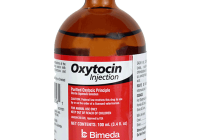
Oxytocin use in the mare during breeding – Delayed Uterine Clearance and Breeding-Induced Endometritis problems can be helped by Oxytocin use when breeding a mare! By Jos Mottershead Oxytocin acts on smooth muscle in the body, causing it to contract. One such area of tissue, which is of tremendous importance relative to breeding, is the mare’s uterus and… Read More: The Oxytocin Protocol! »
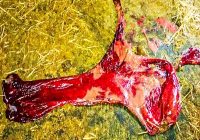
Late Term and Habitual Abortion in the Mare – Pregnancy loss in the mare is a constant source of concern among breeders. Here some common causes are discussed. By Jos Mottershead Late term and habitual abortion in the mare is a constant source of concern among breeders. It may be as a result of identifiable repetitious causes, or… Read More: Abortion in the Mare – Some Pointers »
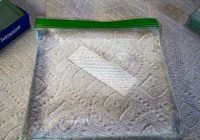
Constructing An Emergency Slide Warmer – Sometimes lab equipment may not be available, so one has to become inventive. An emergency slide warmer is one such piece of equipment! By Jos Mottershead Sometimes lab equipment may not be available, so one has to become inventive. An emergency slide warmer is one such piece of equipment! Easily constructed –… Read More: Warming Semen in the Field »
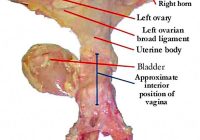
The Equine Uterus Dissected – Here we show the gross aspects of a mare reproductive tract dissected with labels and explanations. The caudal aspect (back end) of the cervix protrudes into the vagina and is often described as having an appearance and feel of a “small volcano”. There is a depression in the center, which is the opening… Read More: The Mare Reproductive Tract Dissected »
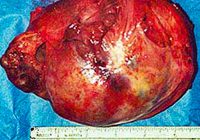
Granulosa Cell Tumor – Capable of affecting reproductive ability and overall disposition, the GCT is one of the most common ovarian tumors to be found in the mare. By Jos Mottershead Granulosa cell tumors – GCT – or granulosa-thecal cell tumors are one of the most common ovarian tumors to be found in equines. They are usually benign… Read More: Most Common Ovarian Tumor »
Persistent Anovulatory Follicles – Anovulatory Hemorrhagic Follicles, Luteinized Unruptured Follicles, PAFs, AHFs, LUFs – all follicular headaches in the mare! By Jos Mottershead You’re following a mare’s follicular development using ultrasound prior to breeding and are relieved to see a good sized follicle developing. Unusually, the follicle continues to develop beyond the size at which you normally see… Read More: Anovulatory Hemorrhagic Follicles (AHF) »
Indications of Impending Ovulation in the Mare – Predicting ovulation in the mare can be a challenge with mares displaying different characteristics. Here we describe some common signs. By Jos Mottershead Predicting ovulation in the mare can be difficult, as they have the capacity to be notoriously unpredictable in their timing! This can lead to frustration, aggravation and… Read More: Predicting Ovulation »
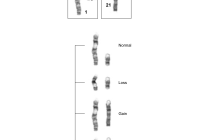
Early Embryonic Loss and Genetics – Chromosomal translocations in horses may be a cause of early pregnancy loss or pregnancy failure. Dr. Teri Lear discusses the issue. By Dr. Teri L. Lear Chromosomes are large segments of DNA wound around special proteins within each cell’s nucleus. They contain nearly all of the body’s genetic material. Horses have 64… Read More: Chromosome Translocation »
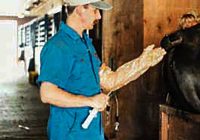
AI (Artificial Insemination) – Artificial Insemination of the Mare is not a difficult task to perform. Here we describe using an aseptic technique in detail. The actual process of artificial insemination of the mare is not complicated, and can be learned very quickly. Unlike artificial insemination in cattle which involves guiding the insemination pipette through the cervix via… Read More: Artificial Insemination Method »