Although the foaling season in the northern hemisphere is almost over, it’s about to start in the southern hemisphere, so there’s always someone foaling somewhere. With that in mind, our foaling prediction article is now updated! We’ve added some information about equipment newly available – particularly the C6 Evos foaling system (www.foaling-alarm.com) – and fine-tuned some of the… Read More: Updated Foaling Prediction Article »
Predicting Foaling in the Mare: What Actually Works Kathy St. Martin and Jos Mottershead Waxing: The Least Reliable Sign There are many signs predicting foaling in the mare: softening of the tail head and vulva, enlargement of the udder, subtle changes in body shape, occasional shifts in disposition, and “waxing”—the appearance of wax-like droplets on the ends of… Read More: Predicting Foaling in the Mare »
ISER XIII “Snippets” – Held in Brazil in August 2023, ISER XIII produced a variety of useful research with immediate clinical value, here we review some of the presentations The thirteenth International Symposium on Equine Reproduction (ISER XIII) was held in Foz do Iguaçu, Brazil between July 10th–14th, 2023. Around 400 veterinarians, researchers and animal scientists were present,… Read More: ISER XIII »
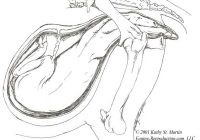
Backwards Foalings – reverse presentations of the foal – are rare but present particular difficulty. Potential for repetition is also present By Professor John Newcombe, BVetMed, MRCVS Backwards foalings – reverse presentations of the foal – are rare but present particular difficulty. Potential for repetition is also present. Lay abstract In posterior (backwards) or caudal presentation, the foal… Read More: Backwards Foalings »
When lecturing on equine reproduction our lead lecturer Jos Mottershead often comments that there are several words to lose in order to avoid confusion and – plainly – being incorrect. The words he always cites are “never” and “always”, because the moment that one uses those words, invariably someone in the audience comes up with a situation which… Read More: Words To Lose! »
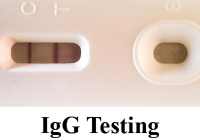
Failure of Passive Transfer in Neonatal Foals – low IgG – can lead to potentially fatal complications, but is easily managed in most with testing and supplementation By Jos Mottershead Foals are born with little or no immunity to infection from outside organisms. There is a minimal amount of immunoglobulin-M (IgM) produced in-utero, but insufficient to ensure adequate… Read More: Failure of Passive Transfer »
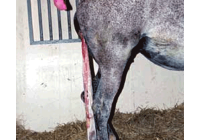
Retained Fetal Membranes in the Mare – Post foaling retention of placenta and membranes. Noted reproductive vet Dr. Jon Pycock discusses at what point this becomes a problem, and how to treat it. By Dr. Jonathan F Pycock, B.Vet.Med., Ph.D., D.E.S.M., M.R.C.V.S. Equine Reproductive Services, Messenger Farm, Ryton, Yorkshire The mare illustrated here is presented to you four… Read More: Dealing with Retained Fetal Membranes (Placenta) »
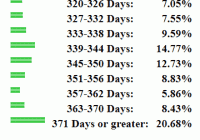
Is my mare overdue? – A question frequently asked by concerned owners and discussed here with possible answers and statistics related to gestational durations. By Jos Mottershead Note: Please review the statistics at the foot of this page. If you have gestational duration information on your born-live colt or filly foal, please add it and assist us in… Read More: Is my mare Overdue? The Perennial Panic! »