Cryptorchidism in the colt
by Jos Mottershead
What is Cryptorchidism in the Colt?
Before birth, the colt’s testes are located within the abdominal cavity. Testicular descent normally occurs during late gestation or shortly after birth1. Sometimes for a variety of reasons one or both (more commonly one) do not descend as they should. Failure of one or both testes to reach the scrotum results in cryptorchidism. The retained testis may remain within the abdomen, near the internal inguinal ring, or within the inguinal canal.
What are the Different Testicular Positions in the Cryptorchid?
There are several types of cryptorchidism, or testicular retention.
Complete abdominal retention is the hardest to deal with where the testicle is fully retained in the abdomen, and is mobile within the abdominal cavity. Typically this testicle will be small and flabby. It is extremely unlikely to produce clinically significant numbers of fertile sperm, although rare cases of sperm production have been reported.
What could be described as “partial (incomplete) abdominal retention” is only marginally easier to deal with, in that the retained testicle is not mobile within the abdominal cavity, but is usually located close to the deep inguinal ring, with portions of the testicle’s attached tissue passed through the vaginal ring, where it can sometimes be palpated externally with the horse standing, and often when the horse is laid down under anesthesia. In some cases, the portion of the testicle which is palpated is mistaken for the entire testicle, and it may be thought that the retention is not abdominal, so care is required to determine exactly how much and what aspect of the testicle is present. Ultrasonography is used for diagnostic purposes to identify the testicular position and provides useful confirmation, and is particularly accurate when combined with endocrine (hormonal) testing (q.v.)1,2.
Inguinal retention is where the testicle has descended through the deep inguinal ring, but is trapped within the inguinal canal. It is difficult or impossible to palpate standing, although may be palpable upon the horse being laid down under anesthesia. Caution should be used in that it is possible to mistake the results of this palpation for those of an incomplete abdominal retention. In both instances the tail of the epididymis within a vaginal process may be felt. Either testicle can be retained, with the other testicle also possibly being retained abdominally. An animal with this condition is sometimes known as a ‘high flanker.
A delayed or potentially transient inguinal retention is the condition that holds the most hope for the horse’s owner. The retained testicle may be palpable within the inguinal canal with the horse standing, but will certainly be palpable with the horse laid down under anesthesia. Either testicle may be retained. The distribution between right and left testes varies among studies and breeds, although left abdominal retention is commonly reported3,. With this type of retention the testicle in some cases may descend of its own volition by the time the colt is three years of age or even later, however delaying management and “hoping for the best” is generally not an optimal choice. In prepubertal colts with an inguinally retained testicle, treatment with human chorionic gonadotropin (hCG) may facilitate testicular descent. In one study of appropriately selected prepubertal Thoroughbred colts, 4 of 8 inguinally retained testes descended following repeated hCG administration4. hCG should not be expected to cause descent of an intra-abdominally retained testicle.
Is the Cryptorchid Colt Fertile?
Except as otherwise noted, and in some cases of temporary inguinal retention, sperm production from an abdominally retained testicle is typically absent or severely impaired. This is primarily because normal spermatogenesis requires the testis to be maintained at a temperature several degrees below core body temperature, a condition that is not provided by an abdominally retained testis. Sperm production may occasionally occur when an inguinally retained testicle lies sufficiently close to the scrotum to maintain a lower temperature. It should be noted however that if the contralateral testicle is normally descended and functional, fertility will generally be maintained, although total sperm output may be reduced.
The cryptorchid may not be capable of producing viable sperm, but a retained testis remains hormonally active and can produce sufficient testosterone to produce normal stallion-like behavior, although testosterone production may be lower than that of a normally descended testis. This means that once the animal reaches puberty (typically during the first two years of life), he will start to act in a stallion-like manner, which can be dangerous for those not familiar with it, and inconvenient for those that are. Additionally, at this stage the stallion will be capable of covering a mare. In the event that only one testicle is retained, the second testicle will be likely to still be fully functioning, and therefore any mare covered may become pregnant. Evidence supports a heritable component to cryptorchidism in horses9, although the precise genetic mechanism and mode of inheritance have not been established and the condition appears to be multifactorial rather than a simple Mendelian trait1,2. Increased castration costs may result for male offspring that inherit the condition, and lower total numbers of sperm produced will be inclined to make any affected animal less fertile. Because cryptorchidism appears to have a heritable component, breeding affected stallions may contribute to perpetuation of the condition within a population and is generally discouraged.
How is Cryptorchidism in the Colt Identified?
The most obvious diagnostic is the absence of either or both testicles upon palpation. Colts may however draw their testicles up closer to the body for a variety of reasons – cold weather or being under threat for example – which may make it more difficult to physically palpate them. Added to this, the colt may not be particularly amenable to having the testicular region palpated, so sedation is often required for a good determination. In some cases, it may be necessary to lay the colt down under anesthesia to obtain a good physical diagnostic determination.
Failing definitive identification of a testicular structure upon palpation, the most useful single endocrine test for detecting retained testicular tissue (or to confirm a previously unrecorded gelding) is an assay for Anti-Müllerian hormone (AMH). As the presence of AMH indicates testicular tissue – not specifically a normally functioning testis – if levels are elevated, then in the absence of an identified testicle testicular retention is indicated6. It should be noted that rare false-negative results can occur, particularly with severely degenerated or very small amounts of testicular tissue. An hCG stimulation test, with measurement of the resulting testosterone concentration, can be another useful adjunct diagnostic to confirm testicular tissue presence1. It is important to understand that these diagnostics cannot identify the position of the testicular tissue, only that it is present, so further diagnostics – typically in the form of either or both transrectal and transabdominal ultrasound – will be required to determine position.
What other Risks are Associated with Cryptorchidism in the Colt?
Behavioral problems are the most obvious, but there are also medical risks, as retained testes are at increased risk of testicular neoplasia, although the absolute risk in horses is difficult to quantify because most cryptorchid horses are castrated5. Additionally, an abdominally retained testicle, as it is not secured, may undergo torsion of the spermatic cord, potentially resulting in acute abdominal pain and colic7,5.
How is Cryptorchidism in the Colt Resolved?
The obvious resolution is castration, which may involve increased costs depending upon the degree of retention, and therefore what level of surgery is required. Historically, abdominally retained testes were commonly removed through laparotomy under general anesthesia. Today, standing laparoscopic cryptorchidectomy is an established treatment for appropriately selected abdominal cryptorchids and can avoid the risks, recovery and expense associated with general anesthesia and recumbency3.
My Gelding is Behaving Like a Stallion – is he a “Rig” or “Proud Cut”?
Dominant behaviour in apparently castrated males (geldings) is sometimes put down to the horse being a “rig” or having been improperly castrated. While this may be the case, generally it is not8. Although retained testicular tissue or incomplete castration can cause stallion-like behavior, persistent stallion-like behavior in a gelding is more often associated with factors other than retained testicular tissue. An important point to consider is that a gelding, even when completely castrated and infertile, may still retain the ability to gain an erection and the behaviour of mounting – and even achieving intromission – with a mare. As determination by palpation can be less than reliable in many instances and a failure to identify a retained testicle may lead to a misdiagnosis, the above mentioned endocrine tests possibly coupled with ultrasound if indicated, should be performed for definitive confirmation. For clarification of terminology: “Rig” is commonly used to describe a cryptorchid or incompletely castrated male, whereas “proud cut” is commonly used for a gelding with persistent stallion-like behavior after castration; terminology varies among horse owners and regions.
Cryptorchidism in Older Horses
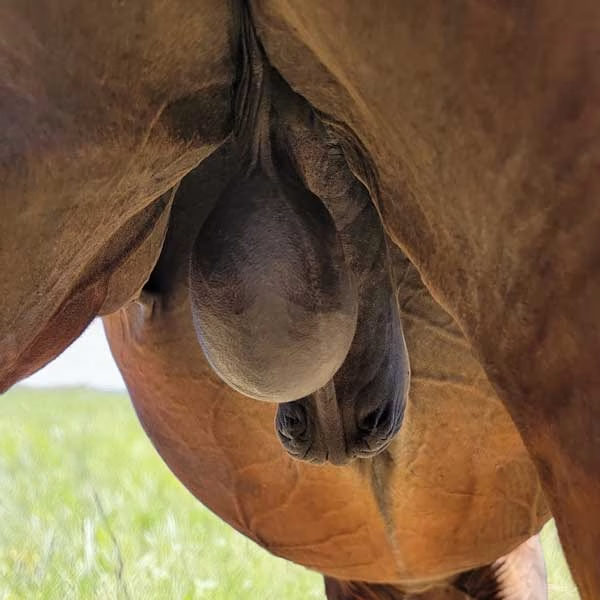
In the older horse presenting a single testicle can be a puzzle if history is unknown (this horse had an inguinal hernia repaired, requiring unilateral castration)
While congenital cryptorchidism may of course be encountered in an older horse for which there is no reliable history, it is important to also understand that there are other reasons why a stallion may only have one testicle present. Besides the obvious animal which was born that way and never corrected, the stallion may have required removal of a single testicle at some point. Causes for such a unilateral castration may include (but not be limited to), neoplasia (seminoma, Sertoli cell tumor etc.), previous surgery associated with an inguinal hernia, or traumatic injury, including kicks or other trauma sustained during covering or handling. It should therefore not be immediately presumed that the stallion may have a retained testicle. Clearly obtaining the animal’s history is useful, as while endocrine tests such as AMH and hCG-stimulated testosterone may still provide useful information about the presence and function of testicular tissue, their interpretation is different when unilateral castration has occurred and they cannot by themselves establish whether an absent testis was retained or previously removed. Ultrasonography remains the principal imaging modality for determining whether additional testicular tissue is present and, when present, for determining its location.
Summary
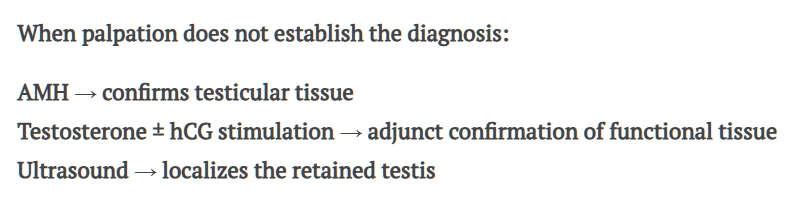
A useful diagnostic sequela
Evidence supports a heritable component to cryptorchidism, although the precise genetic mechanism has not been established. Because of this potential heritable component, breeding affected stallions is generally discouraged. Neither is it desirable for management purposes, as affected animals – while perhaps not fertile (in the case of bilateral cryptorchidism) – will be likely to display stallion-like behaviour and responses, making them in some cases more dangerous and unpredictable. Once cryptorchidism has been confirmed and the retained testis localized, castration is generally recommended. Depending upon the location of the retained testis, surgical removal may be accomplished by an inguinal approach, standing laparoscopy, or another appropriate surgical technique. Standing laparoscopy can avoid the risks and recovery associated with general anesthesia and recumbency and may reduce overall treatment costs in appropriately selected cases.
References:
1: Fain H, Hendrickson DA, Buesing MT, Griffenhagen G. (2025). Retrospective evaluation of cryptorchid sidedness at Colorado State University between 1984 and 2014 and Oakridge Equine Hospital between 2008 and 2023. Veterinary Sciences;12(9):796. https://doi.org/10.3390/vetsci12090796
2: Nocera I, Moroni R., Fanelli D, Rota A, Di Franco C, Ungari C, Puccinelli C, Gandini M, Giusto G, Vannozzi I. (2025). Cryptorchidism in equid: A retrospective study on diagnostic approach, anaesthesia management, surgical treatment and outcomes. Animals;15(19):2923. https://doi.org/10.3390/ani15192923
3: Straticò P, Varasano V, Guerri G, Celani G, Palozzo A, Petrizzi L. (2020). A retrospective study of cryptorchidectomy in horses: Diagnosis, treatment, outcome and complications in 70 cases. Animals;10(12):2446. https://doi.org/10.3390/ani10122446
4: Brendemuehl JP. (2006). Effects of repeated hCG administration on serum testosterone and testicular descent in prepubertal Thoroughbred colts with cryptorchid testicles. Proc. 52nd Annual Convention of the American Association of Equine Practitioners (AAEP).
5: Peeters CMP, Sterk T, Grinwis G, Giglia G, Rijkenhuizen ABM. (2024). Colic signs caused by a unilateral abdominal seminoma in a Friesian stallion. Equine Veterinary Education;36(8):e176–e184. https://doi.org/10.1111/eve.13956
6: Murase H, Saito S, Amaya T, Sato F, Ball BA, Nambo Y. (2015). Anti-Müllerian hormone as an indicator of hemi-castrated unilateral cryptorchid horses. Journal of Equine Science;26(1):15–20. https://doi.org/10.1294/jes.26.15
7: Hunt RJ, Hay W, Collatos C, et al. (1990). Testicular seminoma associated with torsion of the spermatic cord in 2 cryptorchid stallions. Journal of the American Veterinary Medical Association;197:1484–1486.
8: Omyla K, Conley A, Dini P. 2023. Persistent stallion-like behavior is rarely associated with changes in hormonal markers in the equine cryptorchid suspects: a retrospective study. JEVS 125:104607 – see our ISSR-8 paper summary.
9: Eriksson S, Jäderkvist K, Dalin A, Axelsson J, Lindgren G. 2015. Prevalence and genetic parameters for cryptorchidism in Swedish-born Icelandic horses. Livestock Science 180:1–5. https://doi.org/10.1016/j.livsci.2015.06.022
© 2000, 2020, 2026 Equine-Reproduction.com, LLC
Use of article permitted only upon receipt of required permission and with necessary accreditation.
Please contact us for further details of article use requirements.
Other conditions may apply.