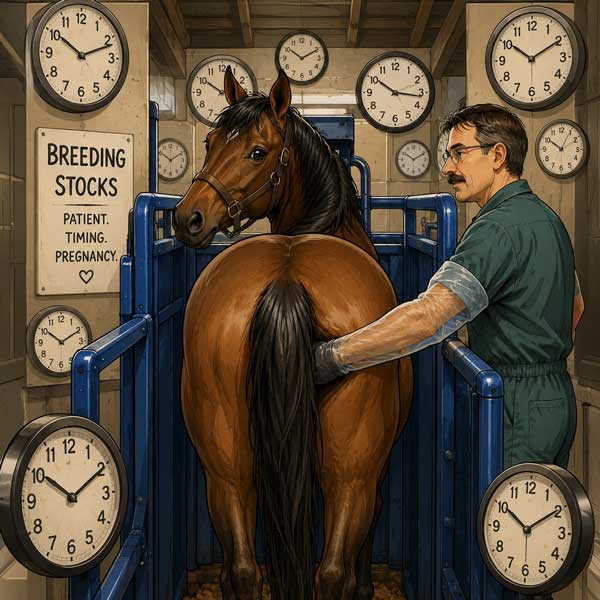
Timing Protocol Modification for Frozen Semen Insemination in Mares
There are in use a variety of protocols for frozen semen insemination. This research compares the results from several currently used with those from a new timing protocol.
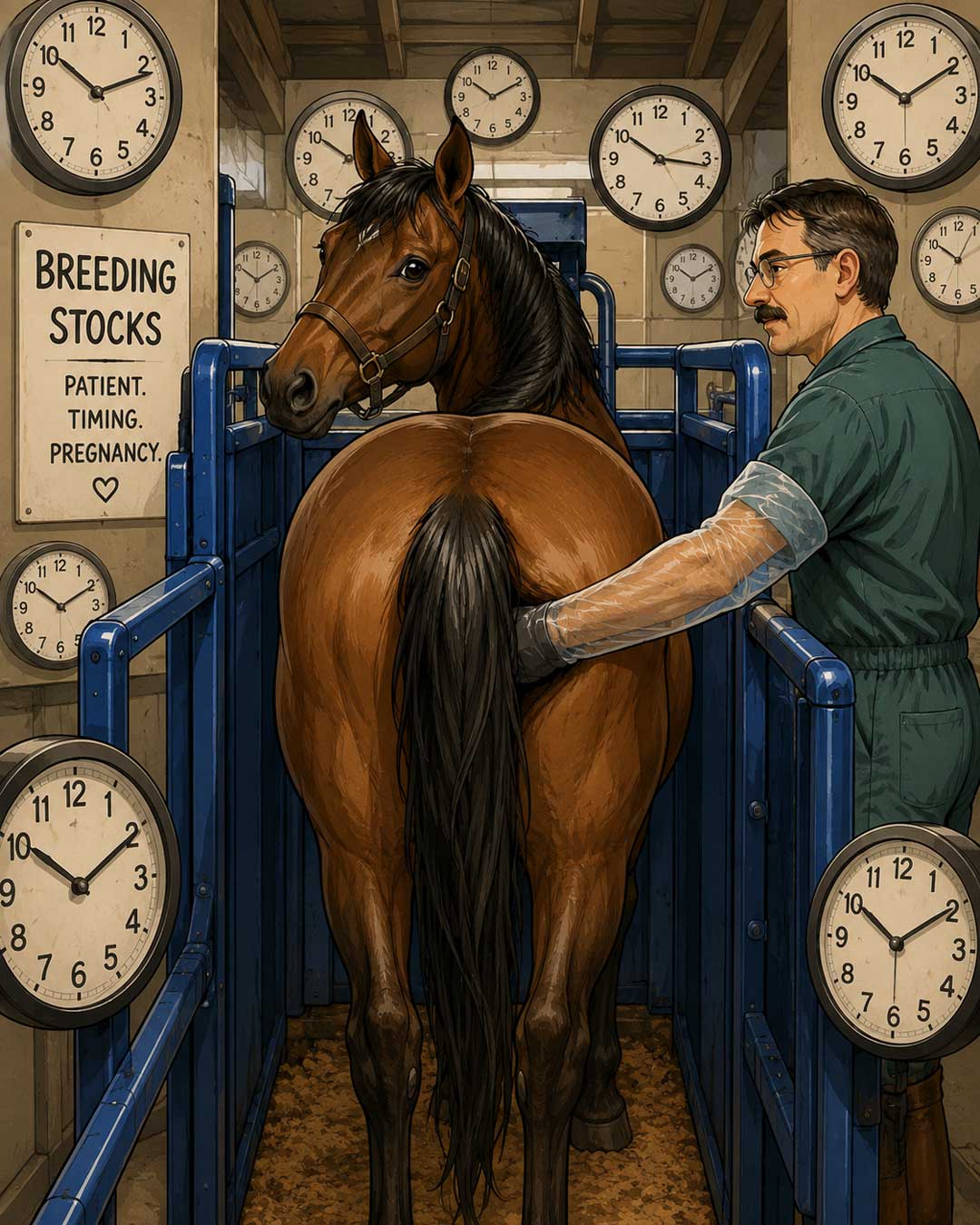 Background:
- There is a growing demand for use of frozen semen in equine artificial insemination practices
- Classic protocols rely on time-intensive mare examination using post-ovulation insemination
- Study goal: reduce examination frequency and eliminate the need for a second insemination
Study Design:
- 67 mares (ages 3–22), 127 cycles across 3 years; multiple breeds
- Ovulation induced (time = 0h) when criteria met: dilated cervix, uterine edema, follicle >35mm
- Induction agents: hCG 3,000 IU IV, deslorelin acetate 1.7mg IM, or histrelin 0.5mg IM
- Three protocols compared:
| Protocol | Examinations | Insemination Timing |
|---|---|---|
| 6 Hour | Every 6h until ovulation | At ovulation detection |
| Timed | 24h, 30h, 48h | 30h and 48h |
| Proposed | 24h, 30h, 33–36h, 48h | 33–36h (single dose) |
Results:
- Pregnancy rates per cycle: Proposed 69.2%, Timed 44%, 6 Hour 48.6%
- No statistically significant difference between groups
Conclusions:
- Proposed protocol achieves comparable pregnancy rates using a single frozen semen dose
- Eliminates examinations between 10PM–8AM, directly improving clinician wellbeing
- Limitations: retrospective design; small Proposed group sample size (9 mares, 13 cycles)
(Hayna J, Ragon A, Hubner A. 2025. Protocol modification for frozen semen insemination in mares. JEVS 145:105292. JEVS 145:105277 – Presented in Association with and by Permission of the International Society for Equine Reproduction)