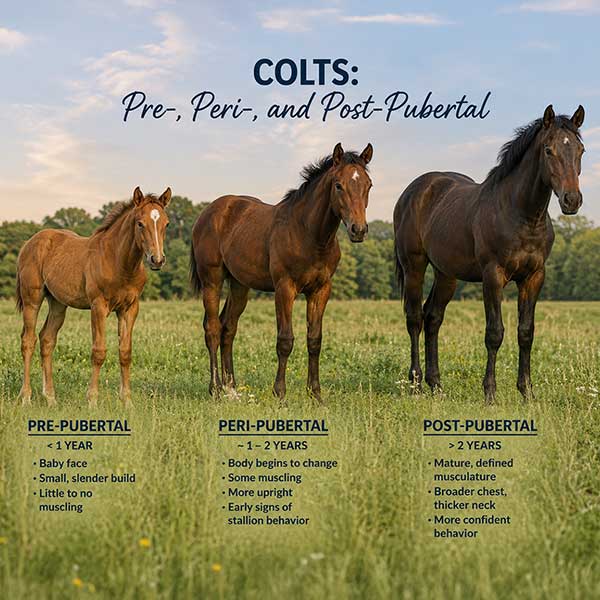
Predicting Breeding Soundness in Pre-, Peri- and Postpubertal Colts
Background:
- The study aimed to identify parameters for predicting breeding soundness in colts at the youngest possible age
- Rearing colts for breeding is costly; early prediction of future fertility has significant economic value
Study Design:
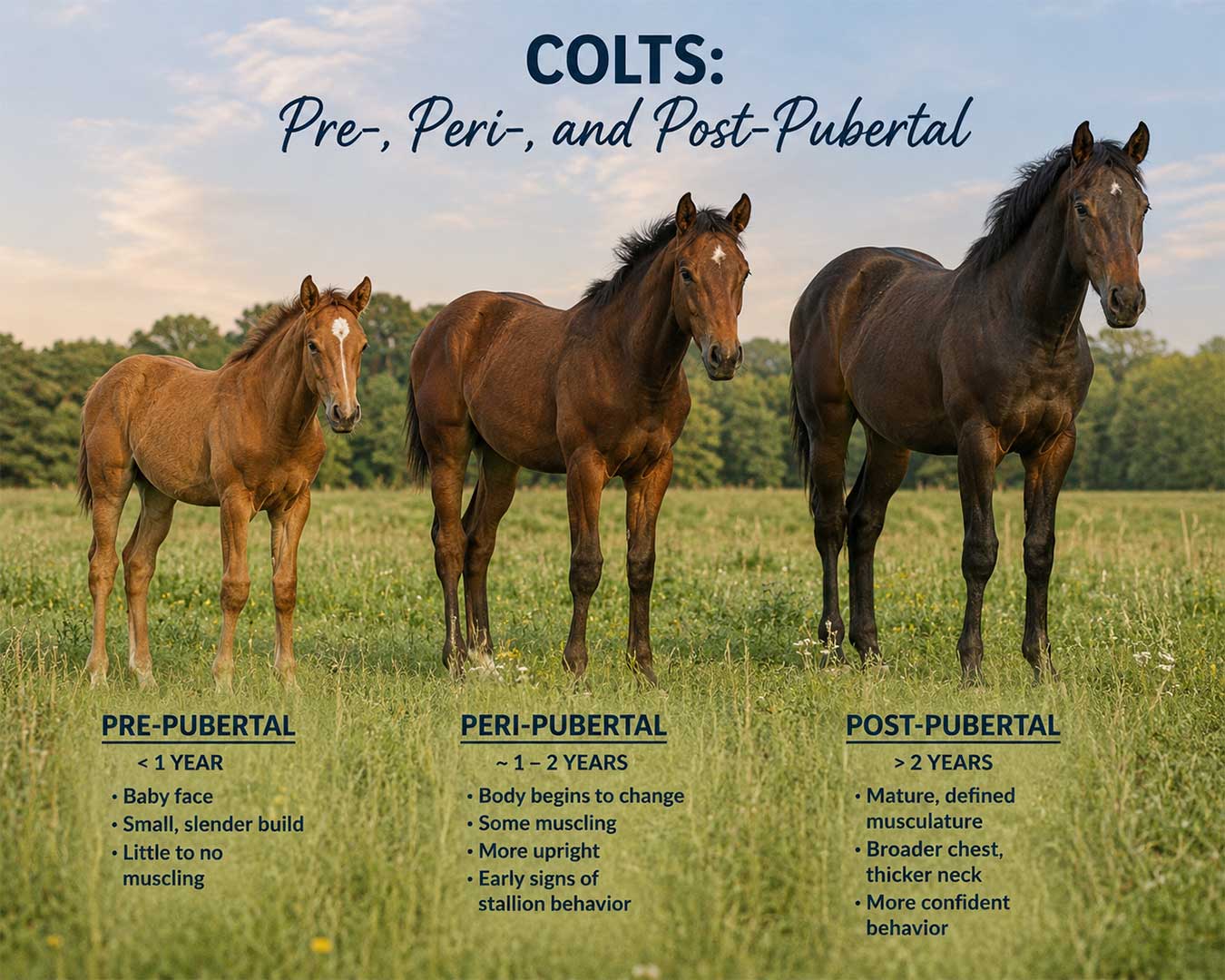
- 46 Warmblood colts examined at approximately 6 months, 20 months, and 30 months of age
- Assessments included: body condition scoring, weight, and testicular palpation, ultrasound and volume measurement
- Blood sampling before and after human chorionic gonadotropin stimulation (5,000 IU intravenously)
- Hormones measured: anti-Müllerian hormone (basal) and testosterone (at 0, 2, 24, and 72 hours post-stimulation)
- 12 stallions at 2.5 years were evaluated for sperm quality; grouped by testicular volume and palpation findings
Key Results:
- No significant difference in morphologically normal or progressively motile spermatozoa between groups
- Stallions with small testes showed lower membrane-intact spermatozoa and higher acrosome reaction rates
- Body condition score positively correlated with progressively motile spermatozoa (r=0.765, p<0.05)
- Anti-Müllerian hormone was highest in peripubertal colts; did not differentiate abnormal from normal testes
- Human chorionic gonadotropin stimulation increased testosterone most strongly in postpubertal stallions at 72 hours
Conclusions:
- Early predicting breeding soundness in colts from pre- or peripubertal parameters is not currently possible
- Palpatory findings and testicular size are inconsistent in young colts, except in cases of cryptorchism
- Body condition score meaningfully influences sperm quality in postpubertal stallions and warrants monitoring
(Köhne M, von Rintelen-Feldmann A, Papkalla M, Tönissen A, Martinsson G, Schmicke M, Sieme H. 2025. Prediction of breeding soundness in pre-, peri- and postpubertal colts. JEVS 145:1052958 – Presented in Association with and by Permission of the International Society for Equine Reproduction)