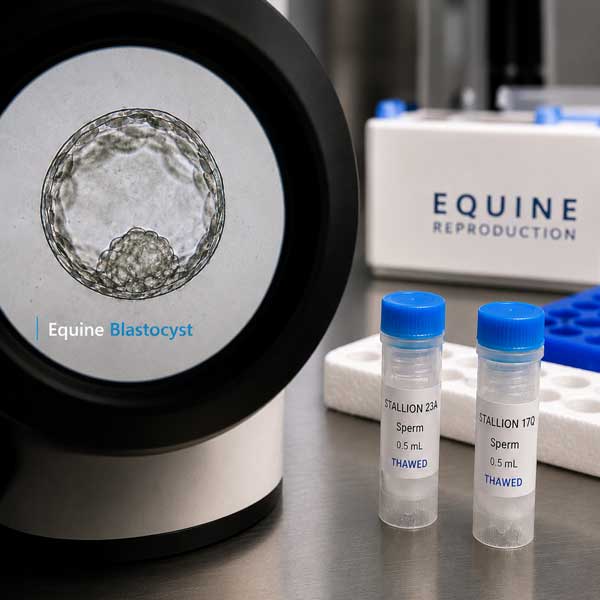
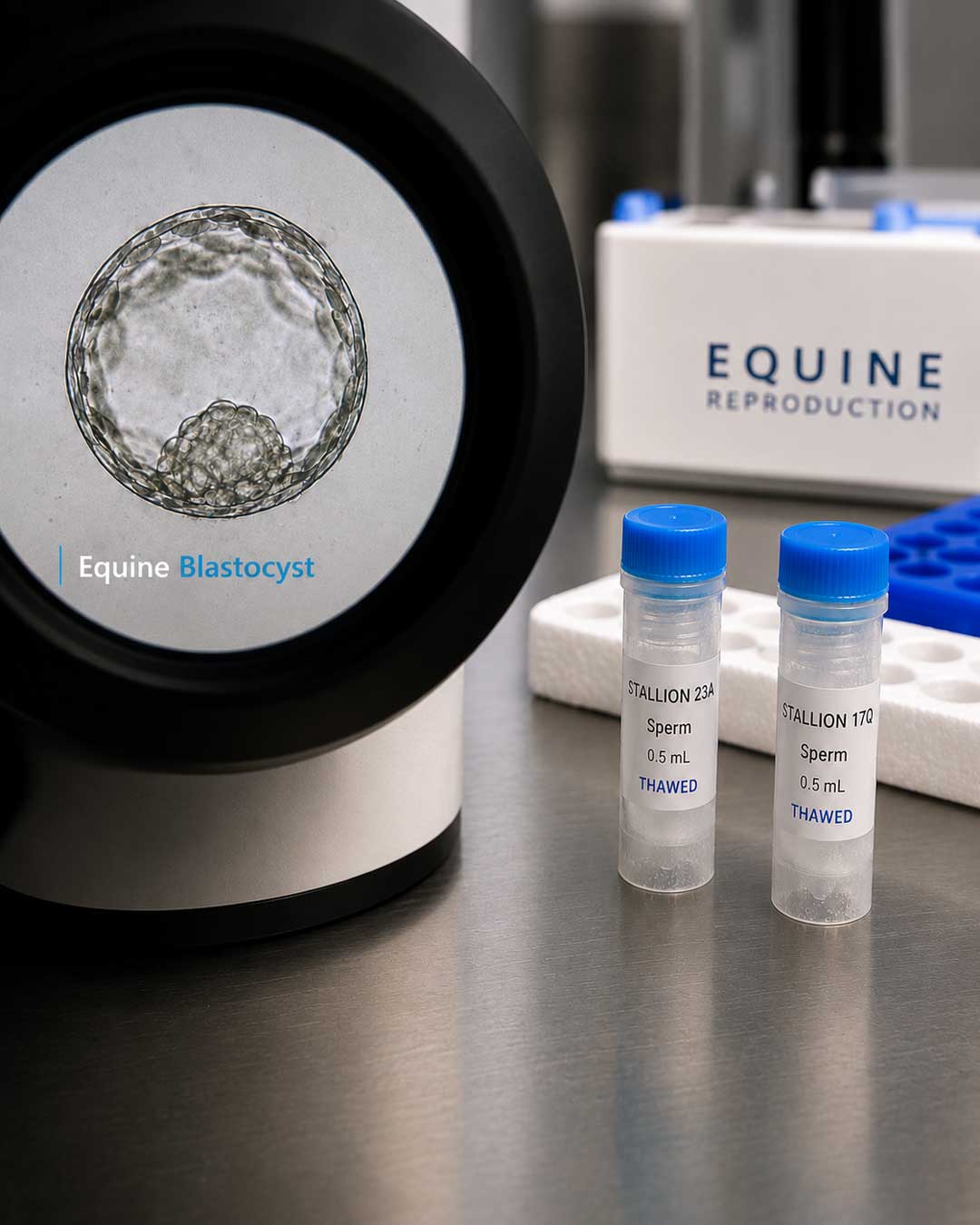
Post-Thaw Sperm Quality and Blastocyst Production Following Intracytoplasmic Sperm Injection in Mares
Post-thaw sperm quality effect on ICSI outcome is well-recognized, and this research reviewed correlations with possible clinically applicable screening criteria assessable in standard laboratory settings.
 Background:
- Intracytoplasmic sperm injection is widely used to maximize semen availability from stallions with limited supply
- The relationship between standard frozen/thawed sperm quality measures and embryo production via intracytoplasmic sperm injection remains poorly characterized
Study Design:
- Frozen/thawed semen from 44 stallions analyzed in a commercial intracytoplasmic sperm injection program
- Sperm assessed before and after swim-up selection for: total and progressive motility (subjective and computer-assisted), morphology, and DNA damage
- 485 in vitro-matured oocytes from 59 mares injected across 85 transvaginal aspiration cycles
- Stepwise logistic regression used to identify predictors of cleavage and blastocyst production
Program Efficiency:
- In vitro oocyte maturation rate: 64%
- Cleavage rate at day 5: 62%
- Blastocyst rate per injected oocyte: 29%
- Blastocyst rate per cleaved oocyte: 46%
- Total blastocysts produced: 139 (1.64 per session)
Key Results:
- Positive predictors of blastocyst production:
- Higher total motility before swim-up (subjective and computer-assisted)
- Higher percentage of morphologically normal spermatozoa
- Negative predictors of blastocyst production:
- Proximal cytoplasmic droplets after swim-up
- Coiled tails before swim-up
- Elevated sperm chromatin structure assay fragmentation index before swim-up
- No single parameter predicted cleavage rate
Conclusions:
- Pre-swim-up motility and normal morphology are the strongest positive indicators of intracytoplasmic sperm injection success
- Sperm structural defects and DNA damage are significant negative predictors
- Post-thaw sperm quality effect on ICSI is well-recognize and findings provide clinically applicable screening criteria assessable in standard laboratory settings
(Hernandez-Aviles C, Love CC, Ramirez-Agamez L. 2025. The relationship between post-thaw sperm quality and blastocyst production following Intracytoplasmic Sperm Injection (ICSI) of in vitro-matured equine oocytes. JEVS 145:105293 – Presented in Association with and by Permission of the International Society for Equine Reproduction)