Setting Up For Semen Collection and Transport
One of the most commonly asked questions that I hear is “what do I need to get started to collect for transported semen?”
Collection of semen and the preparation for transport or on-farm A.I. is not difficult, although care, knowledge and attention to detail is required in all stages. There is also a financial requirement in that there is some basic equipment that is essential, and if one chooses to get “fancy” (or lazy!) there is a whole host of other equipment that can be bought as well.
Before I actually get into a discussion of what equipment is required, it is worth noting that anyone starting out with semen collection should go to a short course such as is offered by us (see more about that by going here). Failing that, seek out a farm or business that is already processing semen, and is willing to allow you to “ride along” and learn.
Semen is fragile and if not handled in a responsible and educated manner, will very quickly lose its viability. So much can cause harm – exposure to sudden changes of temperature, sunlight, many toxic substances – even air and water under the wrong circumstances are toxic to sperm. In fact, it’s one of life’s ironies that seminal plasma itself is toxic to sperm over an extended period of time!
So assuming that you have either completed a course, or “hung out” with your friendly neighbourhood equine veterinarian, let us look at what is going to be essential equipment:
Artificial Vagina
Generally semen is collected using an artificial vagina (“AV”) although there are other methods that are discussed elsewhere on this site. A discussion of the merits of various different types of AV can be obtained by “clicking” here, although it should be noted that IMV’s INRA “French” AV and BotuPharma’s Brazilian AV are greatly favoured by Equine-Reproduction.com, LLC
Once you’ve chosen the A.V. that you feel is suitable for you and your stallion, you will have to get the associated equipment required to fill it and use it. This would include such items as a thermometer capable of registering up to about 60° Celsius; disposable liners if you’ve chosen to use them (very convenient, and save on cleaning the AV, and reduce the danger of cross-contamination if more than one stallion is being collected); a suitable lubricant – you should note that not all lubricants are suitable, the “bactericidal” lubricants may be spermicidal. We use mineral oil, which is cheap, and about as harmless as you can find although it cannot be used if a disposable liner is not being used as it will cause the breakdown of the latex liner of the A.V.; disposable rectal sleeves (the sort used for palpations) to apply the lubricant to the interior of the A.V; collection bottles and filters, depending upon what model of A.V. you are using; a funnel to assist in filling the A.V. with water; and a plastic gallon jug, which is useful for putting the water in that you are going to fill the A.V. with, and which allows the temperature of the water to be taken prior to filling.
Microscope
Next on the list is required laboratory equipment. Undoubtedly at the top of the list is a microscope. If you read veterinary journals, you will find that a “phase contrast” microscope is always recommended for semen analysis. Then when you go and check the price of such a creature, the great plans for “collecting at home” often come to a grinding halt, as their price starts at about $3,000! Fear not! For the average “on farm” user, doing basic collections and semen analysis, an ordinary “bright light” microscope will suffice.
You may come across advertisements for microscopes with “heated stages”, and also see recommendations that your microscope for semen analysis have one. Again, this is in the ideal world, but as long as you turn your microscope on ahead of time, there will be some warming of the stage by the light source. You must be aware at all times however, that your microscope stage is not maintaining a perfect 37°, and make adjustments accordingly. If you are looking at a semen sample that has just come from a cooled transporting container, then it will of course have to be warmed! Likewise, if your stage tends to be hot, don’t be surprised to find the sperm on the microscope slide “clumped” and immotile after 10 minutes exposure!
Incubator or Water Bath
As sperm is very heat (or cold) sensitive, you will need an incubator or water bath. This piece of equipment is used to keep anything that is going to come into contact with the semen at body temperature (38° Celsius). As this will include the microscope slides and cover slips, an incubator is easier to use than a water bath. Other items that will need to be stored in the incubator (or water bath) will be the semen extender; any glassware that is to be used, such as a measuring beaker; and at times the semen itself.
Glassware
I mentioned glassware, so maybe I should elaborate a little on that. You will need something to measure the volume of the ejaculate. A glass beaker is good, or a disposable plastic one. The advantage of the plastic one is that you will not have to sterilize after each use, merely throw it away. In the long term of course, the disposable route is more expensive (although unless you are very sure of your sterilization techniques, it is far preferable). The collection bottles that come with the “Colorado” A.V. are graduated, and will give a close enough estimate for the average collection situation, as will the baby bottle attachment that is used with the “Missouri” A.V. or even a centrifuge tube if one is shipping in those. If however you are using all-in-one disposable liners with either of these systems, or are using another collection method, then you will still require some other measuring container. A 250 ml beaker will suffice in most instances – remember you may want to mix the ejaculate and extender in it, so go larger rather than smaller. We use disposable baby bottle liners in lieu of much of the container glassware, they do not however offer accurate measurement of the ejaculate volume although they are cheap and sterile. Another possible alternative for determining ejaculate volume is weighing it, as 1 mg of semen is equivalent to 1 ml of semen.
Microscope slides and cover slips would also be included in the “glassware” category.
Sperm Counting Device

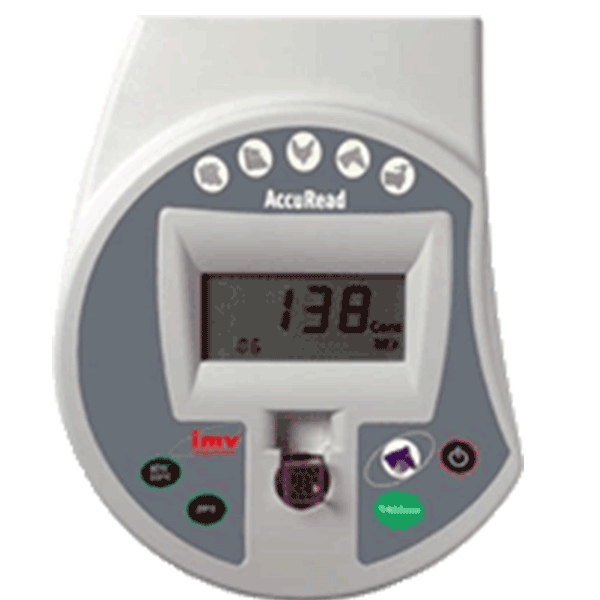
IMV Accuread

Exodus QuickCheck

Spec 20 Spectrophotometer
After the microscope and the incubator, probably the next most important piece of equipment is some form of counting device to establish the concentration in millions per ML (abbreviated as: number x 106/ML). There are a variety of commercially available units, some of which will also calculate the required volume to establish the correct insemination dose. Some of these that we have found useful are the “IMV Accuread” (IMV Technologies, Minneapolis, MN USA); and the “QuickCheck” (Exodus Breeders Corporation York, PA USA). These devices all operate on the principal of a spectrophotometer, which is a machine that measures the light transference through some sort of medium. In fact, you can use a spectrophotometer to do the job. The “Spec 20” model was for a long time the standard of the industry. If you do elect to go with a spectrophotometer, you will have to get it calibrated for equine semen. [A newer, very accurate, but also more expensive counting device now available is the NucleoCounter® SP-100™ (ChemoMetec A/S, Allerod, Denmark)].
If all of the above units are outside your pocketbook range when starting (they are priced at about $1,500 and up), then you will have to resort to the somewhat more time-consuming, albeit actually more accurate, hemacytometer (various manufacturers, cost is around $100). In fact, once you have become familiar with the hemacytometer, and have had some practice, you should be able to establish concentration levels within 10 minutes.
A calculator will also save a lot of time and mathematical effort when calculating insemination doses and extender rates if you are not using a counting device that does the math for you.
Syringes or pipettes will be required for handling the semen, and for getting the correct amount for calculating concentration. If you are using syringes, they should be of the all-plastic, non-spermicidal type (Air-Tite, Vineland, NJ), and not the normal rubber-plungered type.
Semen Extenders
There are a variety of semen extenders available commercially, the majority of which are based on Dr. Bob Kenney’s tried-and-true non-fat-dried-milk-solid (NFDMS) “Kenney” formula. The only variable in the majority of these is what the antibiotic is that is added to it (if in fact there is one). It is advisable when first collecting your stallion each season, to split his ejaculate and store it in several different extenders (i.e. different antibiotics) to establish which he seems to be most compatible with. There is usually a little variation, although sometimes it is negligible. The two antibiotics that I favour the most are Amikacin Sulfate (which is what the “EZ Mixin’ CST” extender from ARS is, as well as other commercially produced extenders), and Ticarcillin (although in Canada this has now been replaced by “Timentin” which is a mixture of ticarcillin disodium and clavulanate potassium). I tend to stay well away from using Polymixin B. Sulfate
in any but on-farm inseminations, as I have found it seems to be more detrimental to longevity that others. Another commonly used antibiotic is Gentamycin, although I have run across some that have the same concerns about the use of this as I do the Polymixin B. Sulfate.
Another extender arrived on the US market in 2003 – INRA ’96 (IMV International, Minneapolis, MN USA). This extender has some unique properties in that it can be successfully used at up to 15° C with some stallions; at low extension ratios (as low as 1:1 semen:extender); and aerobically (i.e. there is no need to remove all the air from the shipment). [A newer range yet of extenders are those from BotuPharma USA (Phoenix, AZ). These extenders are based on caseins with in some cases the addition of cholesterol.] We now always include these extenders in any pre-shipping evaluation we perform on a stallion. Although it is possible to make one’s own extender, for most after determining the most suitable, it is best to go with one of the many commercially available semen extenders (Hoffman Trejo A, Mottershead J. 2017. The effect of home-made semen extenders and commercial semen extenders in the progressive motility of equine spermatozoa. Proc. BSAS:108).
Semen Transport Containers

Equitainer
Without a doubt the best of these is the “Equitainer” (Hamilton BioVet, Ipswich, MA USA). It is also the most expensive initially, but will last for many, many years, and so become by far the cheapest in the long run. (I know of several farms that are still using the old “blue bucket” type that was the original prototype developed almost 20 years ago!). The Equitainer is the most reliable as far as insulation properties against heat or cold is concerned, and it’s tough plastic shell is immensely durable and will handle the rough handling of courier companies and airline baggage handlers. The Equitainer is the system we use at Equine-Reproduction.com, LLC

BotuFlex from Botupharma (top); Equine Express II from Exodus Breeder Supply (bottom)
There are several “disposable” containers available for use with transported semen as well, such as the “BotuFlex” (BotuPharma USA, Phoenix, AZ) and “Equine Express II” (Exodus Breeders Corporation York, PA USA). These are constructed using a cardboard box with a Styrofoam type insulation. The manufacturers recommend they be used no more than 5 times, and fewer if damage is evident. The trouble with these systems is that they tend to have poorer insulation qualities to start with particularly in temperature extremes, and then if they are subject to rough handling in transit, they can develop “microcracks” which may not even be visible. These microcracks then act as a heat/cold vector to the inside, and hence allow the semen temperature to drastically alter. The price certainly is a bonus initially (usually around $35, as opposed to Equitainer’s $279), and some farms simply add the cost into the stud fee, and don’t bother about trying to get the mare owner to return them. This is actually desirable, as reused disposable containers may not produce optimum results and getting shipment containers returned can sometimes be a nuisance. Another consideration which may tend to make the Equitainer more desirable is a desire to reduce the amount of material placed in landfills. The Equitainer is – as a result of its longevity – more environmentally friendly. We have units which we have been using for more than 30 years. Both the BotuFlex and the Equine Express II do allow for the packaging of the semen in an insemination device, which may be attractive to some. If using one of the other systems, you may require baby bottle liners and elastic bands or centrifuge tubes in which to package the semen. A “permanent” marker is also required to write identification on the outside of the bag, tube or the syringe.
“Outside” Equipment for the Collection Process
The first consideration for “outside” equipment is whether you are going to us a breeding mount (aka phantom mare or dummy), or a live “jump mare”. If you are going to use a breeding mount, then obviously that will have to be bought or constructed. I have built many very serviceable breeding phantoms using sections of telephone pole. Plans for this can be seen elsewhere on the site. Regardless of the type of “mare” you are using, the stallion should, at least at the beginning of the season, have his penis washed off prior to a collection. For this you will require a source of warm water, a bucket, a sterile liner for the bucket (disposable plastic bags will usually suffice), and a sterile plastic cup. It should be noted that research has shown that repeated washing – even with only water – during the course of the season may actually increase the pathogen and organism load on the penis.
Whether you are using a breeding mount or a “jump mare”, it is quite possible you will need somewhere to “tease” the stallion to encourage him to “drop” for the washing process and then to gain an erection prior to collection. Depending on the stallion’s temperament, this teasing can be achieved over a stall door or through stall bars, or it may be that a proper teasing rail is preferred – especially with rowdier stallions that may become too used to teasing over a stall door, and attempt it each time they pass one. If using a breeding mount, some stallions may require the tease mare to be in a close proximity to the phantom, as they may become distracted if the distance is too great, and loose their erection. Others however associate the collection shed with the process and do not require a mare present at all.
The above is a basic list of equipment that the person collecting semen for on-farm or cooled-transported use will need. It is however, just that, and there are many other pieces of equipment that can make the process more efficient, easier, and a whole lot more expensive!
Some other equipment that you could find of use or necessity in the future may include items such as centrifuges, a slide warmer, a refrigerator, a water bath (if you have an incubator for regular use), various sizes of pipettors, and if you have money to spare, the “holy of holies”: CASA, which is “Computer Assisted Semen Analysis” – priced at upwards of $35,000!
© 2000, 2003, updated 2020 Equine-Reproduction.com, LLC
Use of article permitted only upon receipt of required permission and with necessary accreditation.
Please contact us for further details of article use requirements.
Other conditions may apply.