Frozen Equine Semen – An Overview
(with later updates in red)
Frozen equine semen advantages include:
- There are no requirements to schedule shipments of semen to fit the mare’s ovulation time, as frozen semen can be shipped well ahead of the breeding cycle and stored until ready for use;
- The market for semen is global, as there is little limitation in duration of delivery time;
- There is no requirement for the stallion to be taken out of competition for breeding, or to have his competitive attitude possibly disrupted by being bred;
- There is an “insurance factor” in case the stallion should become ill, die, or be unable for some other reason to fulfill live cover/cooled semen breeding commitments;
- As the processing of frozen semen usually requires the involvement of a business that specializes in that processing, there tends to be better control over quality than is sometimes seen with cooled semen. [2021: it should be noted that some private farms are now freezing semen from their own stallions – and sometimes other’s – and while some are very capable, this has also led to a greater variation in quality than was seen when this presentation was first made.]
Frozen equine semen disadvantages include:
- Not all stallions have semen that will freeze;
- Mares require more intense estrus monitoring, as frozen semen is typically inseminated within the 12 hours prior to or 6 hours following ovulation;
- Conception rates for insemination with frozen equine semen are on average a little lower than those seen with fresh or cooled semen [2021: while of course individual results will vary, the averages are now very close to each other and in some cases, pregnancy rates for use of frozen semen may exceed those for cooled;
- To freeze semen is not initially as cheap as to prepare cooled semen, although in the long run it can be cheaper.
The Semen Freezing Process:

Fog surrounding a tank and a shipper while being filled with liquid nitrogen
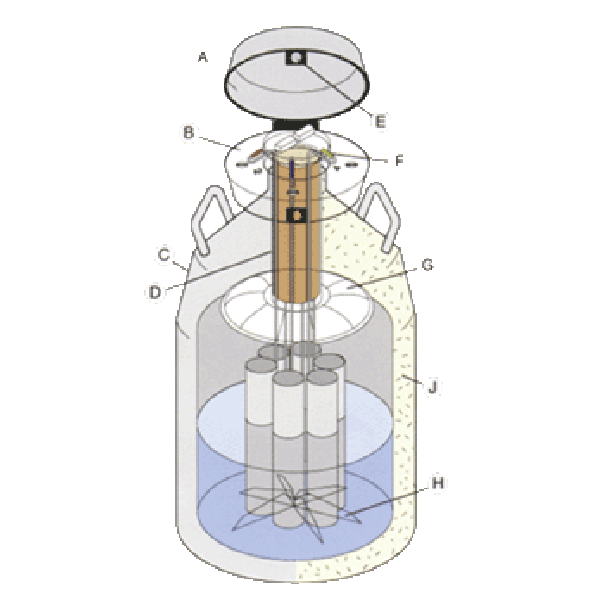
Semen is collected from the stallion in the same manner as collection for cooled transported semen use and is evaluated to establish total sperm numbers and motility levels. The semen is mixed with a centrifugation extender, and the majority of the seminal plasma is removed following centrifugation. The resulting sperm pellet or layer is resuspended to a known concentration in a freezing extender, which contains a nutrient medium, cryoprotectant and buffer. This mixture of sperm and extender is loaded into straws that are lowered in temperature by being exposed to liquid nitrogen vapour for a set time period. After the completion of that timed period, the straws are plunged into the liquid nitrogen, from which they are subsequently removed and placed in a suitable storage container. Alternatively, the freezing part of the process may make use of a mechanical freezer, which lowers the temperature at a specific rate. Once the straws are frozen, they are then transferred to a liquid nitrogen storage tank.
Marketing Semen:
- Semen may be marketed with a full live foal guarantee. If there is no proof however that the stallion has fertile frozen semen, or in the event that there is not a competent inseminator, this may lead to excessive expense for both the stallion and mare owners;
- We generally recommend that semen be marketed with a live foal guarantee, but with a fixed number of insemination doses included in the stud fee (e.g. 3 doses), after which a “per straw” charge is incurred by the mare owner. We also recommend that the frozen semen be proven fertile prior to marketing to the general public;
- Semen may be sold completely on a “per straw” basis. This may however be considered to be counter-productive as it leads to pressures being put on the inseminator to use as small a number of straws as possible – quite often resulting in use of an insemination dose below the recommended minimum;
- A breeding contract should have a clause included to determine what is to be done with straws held by the mare owner in excess of those required to establish pregnancy. This may lead to the opportunity for the selling of a subsequent breeding at a lowered rate, thereby securing a stud fee that may not have been obtained otherwise, and which can serve as a financial benefit to the mare owner.
Frozen Semen and the Stallion:
- Not all stallions’ semen can be successfully frozen and thawed. Roughly 30% of stallions have semen that will be highly fertile post-thaw; 40% “average”; and around 30% show lowered or no fertility;
- Attention to detail is required in all procedures involved in the freezing process. Any part of the process that is not carried out properly will result in a reduction in – or complete elimination of – the number of sperm capable of impregnating a mare. As there are many more steps in the freezing process than there are for preparing cooled semen, the potential for failure is proportionately greater and it is unlikely that the average breeding farm will be able to perform the freezing [2021: as noted above, some farms are now freezing semen with mixed results.];
- Unless pregnancies have been achieved with frozen semen, there is no reliable method to determine whether sperm have survived the freezing process in a manner able to get a mare pregnant. Motility post-thaw does not indicate fertility;
- As long as semen is properly maintained in a liquid nitrogen storage tank, the viability is believed to be nearly unlimited. (10,000 years has been suggested!) Pregnancies have resulted from using semen that has been stored for ten to fifteen years [2021: foals have now been born with semen that has been stored frozen for over 30 years]. Pregnancies have not been achieved with semen that has been re-frozen once thawed.[2021: this technique has now been improved, and although fertility levels are lower, following refreezing, subsequent pregnancies have been established with live foals produced.]
Frozen Semen and the Mare:
- Mare owners should be aware that not all stallions have thawed-frozen semen that is fertile, and would be therefore well advised to ask stallions owners what the “first-cycle conception rate” is, as well as the number of mares that have been bred using frozen semen;
- Frozen semen may be shipped years ahead of the anticipated date of use, thereby avoiding the last-minute anxiety associated with cooled semen shipments, but it must be transported and stored in a proper container;
- A “Vapour Shipper” (aka “Dry Shipper”) is commonly used to transport frozen semen, which does not carry a “HazMat” designation and is therefore not a restricted commodity for carriers;
- The mare must be monitored closely for impending ovulation and insemination is typically performed no more than 12 hours before or 6 hours after ovulation to be consistently successful [2021: research by Newcombe and Cuervo-Arango indicates that pregnancy rates are not negatively affected with inseminations occurring up to 12 hours after ovulation as long as appropriate treatment accompanies or follows the breeding. Additionally use of a timed insemination protocol if multiple doses are available can significantly reduce the requirement for multiple checks.];
- Thawing protocols are simple – using hot water – but times and temperatures must be followed carefully;
- Identification of the stallion whose semen is contained within the straw should be confirmed prior to insemination taking place, typically by review of the stallion’s name which should be marked on the outside of the straw;
- The insemination process is the same as is used with cooled or fresh semen;
- Post-breeding monitoring should be carried out to ensure ovulation has occurred and that there is no fluid present in the uterus as a result of a persistent uterine inflammatory response (and suitable treatment with oxytocin should take place if such fluid is present).
Regulatory Considerations:
- DNA typing of offspring with parentage verification is a normal requirement (as is common with cooled transported semen use) prior to issuance of registration documents;
- Some breed registries issue an individual certificate for each semen straw, which may need to be returned with an AI certificate of breeding. In the event of the death of the stallion only the number of certificates existing at the time of his death will be honoured, or in the event of the stallion’s sale, this provides a distinct document of ownership relative to those semen straws, which may be considered separate from the stallion himself for registration purposes;
- Consideration should be given to use of semen following the death or castration of the stallion. Generally market influence is regarded as being the controlling factor in these cases;
(Additional comment made verbally at the time of the initial presentation: It is worth considering that if a stallion owner has paid to have semen frozen and/or mares have been bred during the breeding season but subsequently lost the pregnancy after year’s end, if the use of frozen semen is limited by the Registry to the end of the year of the stallion’s death, or even the year following, this will be likely to result in breeder discontent, possibly encourage fraud, and really defeats one major advantage of frozen semen – that of “insurance”. We therefore recommend that such a limitation not be imposed by a Registry).
- Over-use of a stallion whose semen is frozen is no more likely than one whose semen is being offered cooled.
© 2001, 2021 Equine-Reproduction.com, LLC
Use of article permitted only upon receipt of required permission and with necessary accreditation.
Please contact us for further details of article use requirements.
Other conditions may apply.